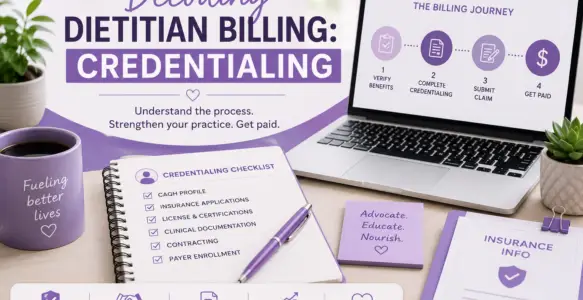

The path to building a profitable private practice is exciting. But let’s be honest: nothing drains that excitement faster than coming face-to-face with the “alphabet soup” of insurance billing.
Acronyms like NPI, CAQH, CPT®, and ICD-10 can make the journey to getting paid feel incredibly unclear and overwhelming. You are a highly trained clinical expert—you shouldn’t feel like you need a translator just to figure out how to get reimbursed for the care you provide.
If you are stepping into the world of insurance, understanding this language is non-negotiable. I know exactly how frustrating this learning curve can be, which is why we are going to clear the fog together. To make it simple, we are breaking down insurance billing into a clear, three-part framework: The 3 C’s (Credentialing, Contracting, and Coding).
Let’s start with Part One: Credentialing.
Proving Who You Are
Before you can ever bill an insurance company, they need to verify your professional background. Credentialing is the formal process used to evaluate the qualifications of a medical professional. Think of it as a comprehensive background check where third-party payers verify your education, licensure, and identity.
1. Secure Your National Provider Identifier (NPI)
To start, you need to secure your NPI. An NPI is a unique, 10-digit, numeric identifier issued by CMS (Centers for Medicare & Medicaid Services) to health care providers in the US. Your NPI is good for life, follows you everywhere, never expires, and is strictly required for electronic claims.
Do you need a Type 1 or Type 2 NPI? If you have established an LLC or a business entity, it is an industry best practice to obtain both:
- Type 1 NPI: For you as the individual human provider.
- Type 2 NPI: For your organization or billing entity.
Getting both establishes a crucial boundary for your financial liability, ensures you meet specific payer contracting requirements, and future-proofs your practice for growth!
2. Build Your CAQH Profile
Once your NPIs are secure, your next immediate step is to set up your profile with the Council for Affordable Quality Healthcare, Inc., or CAQH. CAQH is a secure, centralized online database used to store your demographic and credentialing information.
Instead of manually filling out a 40-page paper application for every single insurance company you want to work with, you enter your information once into your CAQH profile. Payers can then pull your verified data directly from the system.
To build your profile without the headache, gather these documents before you log in:
- Your basic demographics
- Your NPI numbers and Social Security Number
- Business details (including your EIN)
- State dietetic licenses
- Education history
- A current CV (accounting for any employment gaps over six months)
- Your professional liability insurance certificate
- A signed W-9 for your business
Stop Guessing and Start Billing
Navigating the credentialing phase can feel intimidating at first, but mastering these initial steps sets the foundation for a highly profitable, insurance-based practice.
You don’t have to navigate this maze alone. If you are feeling stuck on the credentialing paperwork or just aren’t sure what your very next step should be, let’s talk it through!
Ready to get insurance-ready? Schedule a free “Let’s Chat! 15 min Video Call” with me today, and we will point your practice in the right direction: 👉 Schedule your 15-minute call with Laura here!
Just getting started? This is the perfect time for an Insurance Clarity Call! Read More…